
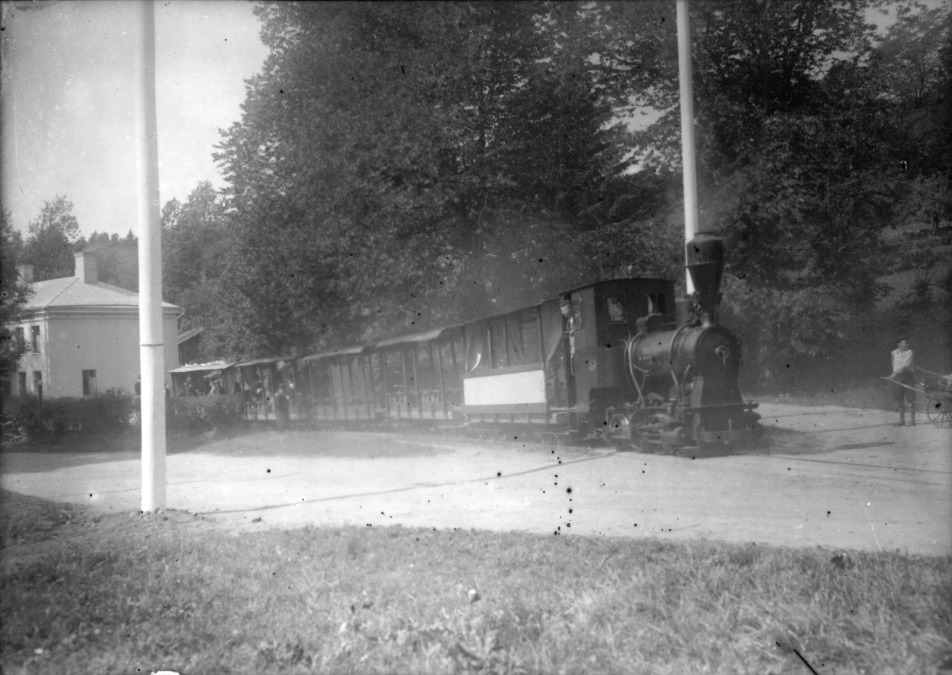
Fiskars steam locomotive “Pikku-Pässi”
Below you can explore materials that present the story of the steam locomotive Fiskars “Pikku‑pässi.” The locomotive is the oldest preserved narrow‑gauge steam locomotive in Finland. Through these materials, you can learn about the history of the locomotive and the narrow‑gauge railway, as well as delve into steam technology and objects related to the history of the train. New materials will be published as they are completed.
Were is the locomotive?
The locomotive is part of the museum’s collection and has been restored to running condition, allowing us to present it as part of our living history concept. The train will be showcased in a newly built locomotive shed in Fiskars from the summer season 2026.
View the opening hours of the locomotive shed
Read more about Fiskars locomotive “Pikku-Pässi”
Explore the history of Finland’s oldest preserved narrow‑gauge steam locomotive by reading our collection of articles.
An exerpt from the short film Fiskars Factories in the 1930’s
The short film produced by Aho & Soldan shows the manufacturing and transport of ploughs, with the steam train “Pikku-Pässi” in Fiskars ironworks during the 1930s.
How does the steam engine work?
The animation illustrates how the Fiskars steam locomotive works. The locomotive’s boiler is fired with wood. Through the fire tubes inside the boiler, the water is heated into steam, which creates pressure. This steam pressure is then directed to the cylinders, where it alternately pushes the piston forward and backward. The movement of the piston is transferred to the wheel‑driving mechanism, causing the locomotive’s wheels to rotate.
Railway car jack
This jack was used in situations where the “Pikku-Pässi” locomotive’s cars had derailed and needed to be lifted back onto the tracks. This object is part of the museum collections.
Fiskars plough No. 10F
Ploughs were manufactured in Fiskars from 1885 until around 1980. The earliest ploughs were made entirely of iron and were intended to be pulled by horses. Transport of the finished ploughs from Fiskars to the harbour in Skuru was carried out using the steam locomotive “Pikku‑Pässi.” From Skuru, the ploughs were delivered for sale throughout Finland.
Drive Pikku-Pässi from Fiskars to Pohjankuru Harbour virtually
Climb into the cab of the Pikku-Pässi locomotive and embark on a virtual train journey from the Fiskars engine shed to Pohjankuru Harbour through a 360° video animation.
Coming soon!